Dragoon
genus
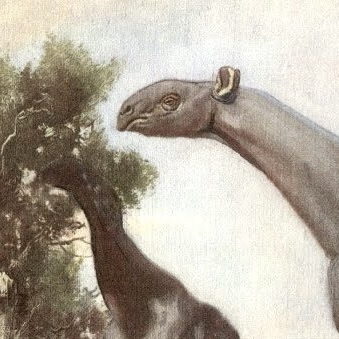
Highland dragoon
(paracetum arcadia)
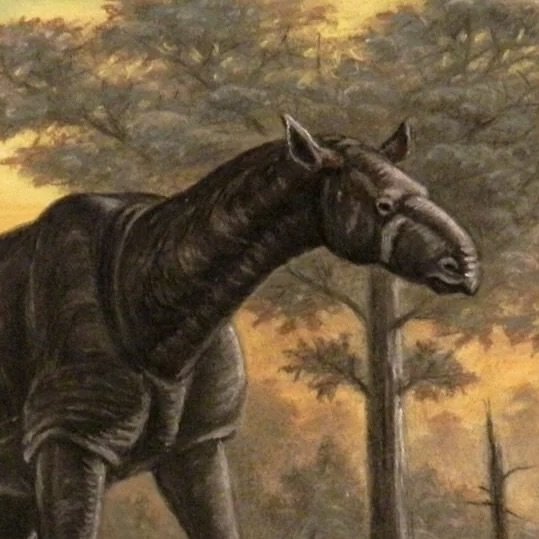
Pygmy dragoon
(paracetum indo)
Description
The dragoon (paracetum) is an odd-toed ungulate in the Hyracodontia family. Both known species of the genus are endemic to Capland.
The dragoon is herbivorous, and lives in the Capland highlands, where it subsists on a diet of pine needles and tree bark. It is amongst the largest known terrestrial animals, with members of the larger highland dragoon weighing in excess of 11 tons.
Scientific classification
Anatomy
The Highland dredge is the largset terrestial animal alive. Adult memebers reach a height of up to 5 metres at the shoulder and 7.5 metres in length.
The dredge is characterised by a long, broad neck and a stout body. The head is small in comparisson to the body, with beady eyes, and a trunk-like, prehensible nose. It uses its nose to find food high up in the coniferous forests. Each of the four stumpy feet has three toes. The clor of the body ranges from yellowish-brown to slate grey. The body is hairless except for a few tuffs of hair around the ears and tail. The highland dredge also has a noticeable hump on the back of its neck
Diet & habitat
The dredge is herbivorous. Its diet consists of conifer needles and bark.
The dredge is entropic to Capland. It can be found in the northern highlands, where it makes it home in the vast, boreal forests. The Highland dredge (vahanacetum arcada) lives in the forests around the Blue Mountains, while the smaller Pygmy dredge (vahanacetum indo) lives in the Cambrian Mountains in northeast Capland.
Behaviour
The dredge is a highly intelligent creature, capable of understanding and mastering commands, and found to have a remarkably long memory.
Most dredge live a solitary existence, roaming and protecting their large territories on their own. They have a calm demeanor, relying on their great size to keep them safe. Pygmy dredge have been found to be more aggresive and territorial, fiercely protecting their territories from invaders. They only meet for the purpuse of procreation. Females are pregnant for 22 months, and give birth to one or two live young. The young stay with their mother for four years, after which they strike out on their own.
Intelligence & cognition
Lorem ipsum dolor sit amet, at mei dolore tritani repudiandae. In his nemore temporibus consequuntur, vim ad prima vivendum consetetur. Viderer feugiat at pro, mea aperiam
Human relations
The highland dredge has succesully been domesticated as a useful beast of burden. It can be found in the streets of both the colonies and on the the Continent. Their strenght and great size make them suitable for farmwork and hard labour, like in the lumber or mining industry. Meanwhile their intelligence make them highly trainable.
The pygmy dredge has been found to be unmanageable for domestication, because of their territorial behavior.
CODEX
Island
Geographic distribution
Lifespan
110 years
Average height
5 m
Average lenght
7,5 m
Average weight
11,3 t
Diet
Herbivore
Domestication
Limited domestication as a beast of burden
Hunted for
None
Scientific classification
Anatomy
The pygmy dredge is noticeably smaller than the highland dredge, with an average height og 4.1 metres at the shoulder and 6.7 metres in length. It has a more squat appearance than the highland dredge, with shorter legs and a longer body. The most noticeable difference though is the amount of hair. The pygmy dredge is covered by a fine layer of whitish-grey fur, that helps keep it warm during the long Capland winters. Biologists believe this adaption is caused by the pygmy dredge’s geographical distribution in the colder eastern corner of Capland.
Diet & habitat
The dredge is herbivorous. Its diet consists of conifer needles and bark.
The dredge is entropic to Capland. It can be found in the northern highlands, where it makes it home in the vast, boreal forests. The Highland dredge (vahanacetum arcada) lives in the forests around the Blue Mountains, while the smaller Pygmy dredge (vahanacetum indo) lives in the Cambrian Mountains in northeast Capland.
Behaviour
The dredge is a highly intelligent creature, capable of understanding and mastering commands, and found to have a remarkably long memory.
Most dredge live a solitary existence, roaming and protecting their large territories on their own. They have a calm demeanor, relying on their great size to keep them safe. Pygmy dredge have been found to be more aggresive and territorial, fiercely protecting their territories from invaders. They only meet for the purpuse of procreation. Females are pregnant for 22 months, and give birth to one or two live young. The young stay with their mother for four years, after which they strike out on their own.
Intelligence & cognition
Lorem ipsum dolor sit amet, at mei dolore tritani repudiandae. In his nemore temporibus consequuntur, vim ad prima vivendum consetetur. Viderer feugiat at pro, mea aperiam
Human relations
The highland dredge has succesully been domesticated as a useful beast of burden. It can be found in the streets of both the colonies and on the the Continent. Their strenght and great size make them suitable for farmwork and hard labour, like in the lumber or mining industry. Meanwhile their intelligence make them highly trainable.
The pygmy dredge has been found to be unmanageable for domestication, because of their territorial behavior.
CODEX
Island
Geographic distribution
Lifespan
110 years
Average height
4,1 m
Average lenght
6,7 m
Average weight
9,8 t
Diet
Herbivore
Domestication
None
Hunted for
None
Discovery
The dragoon was first described in 1812 by Amelia ver Leyen during her journeys through the Capland highlands.